When the Modern Slavery Bill passed its first reading in Parliament earlier this year, some people saw a sudden breakthrough. But from where I sat, it didn’t feel sudden at all. It felt like watching a river wear through rock, little by little, until a new path emerged.
There’s a Scripture verse that has stayed with me throughout this journey:
‘Let justice roll on like a river.’ Amos 5:24
I love the image of God’s justice as a river because rivers can transform landscapes. Their movement can seem slow, almost imperceptible at times. But over time, they reshape what once seemed immovable.
That’s what this advocacy journey has felt like as we’ve tried to bring more of God’s justice to people affected by slavery and exploitation.
When hope for change is challenged
So, let me take you back to where this first started for me. After four years of research through our Ethical Fashion Report, we reached a sobering conclusion: voluntary action by companies wasn’t enough. Some businesses were leading the way, genuinely trying to understand and address exploitation in their supply chains. But unfortunately, they were the exception.
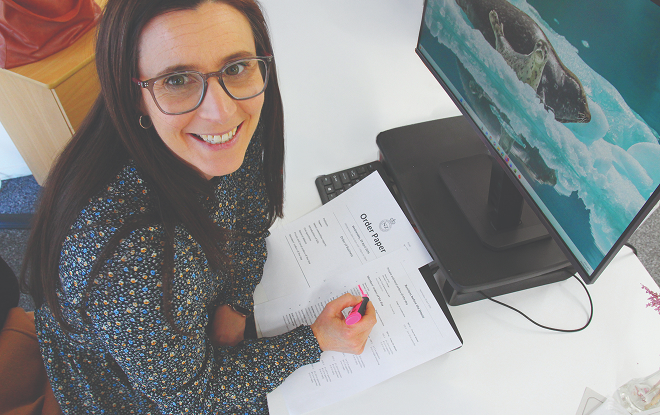
Claire preparing to present the first reading of the Modern Slavery Bill in Parliament.
And so, we made a decision: New Zealand needed modern slavery legislation, something that would create a level playing field and ensure that doing the right thing wasn’t optional.
The momentum grew as, together with Trade Aid and World Vision, we helped deliver a petition to Parliament signed by 37,000 New Zealanders. Later, thousands more people made submissions as the Government explored what modern slavery legislation in New Zealand could look like.
But advocacy journeys are rarely straightforward. There were moments when progress slowed and it felt like nothing was moving at all. At times, it was discouraging. And this is where advocacy can feel hardest; when it seems like you’ve done everything right, and yet nothing quite moves.
But a river doesn’t stop when it meets resistance. It keeps on moving. A new coalition Government was in power, and the pathway forward for modern slavery legislation became far less certain. Luckily, rivers don’t rely on one pathway.
When the terrain changes, they find another route. So, in late 2024, a group of experts drafted a model law for New Zealand. If the system wasn’t advancing the work, the work would still advance.
The persistence of advocates
By 2025, momentum was building again as Modern Slavery Bills were introduced into the private members’ ballot from opposite sides of Parliament. Behind the scenes, people kept working patiently across political and organisational lines. Slowly, something began to take shape.
Finally, the moment we had been hoping for arrived. In January 2026, Greg Fleming (National) and Camilla Belich (Labour) co-sponsored a single Private Member’s Bill.
“This Bill has been the work of many, and it has also been many years in getting to this House
and getting to the stage of first reading.”— Camilla Belich, Labour
And then, on 29 April, the Bill reached its first reading. Listening to the speeches, I found myself thinking less about that moment, and more about all the moments that had led to it.
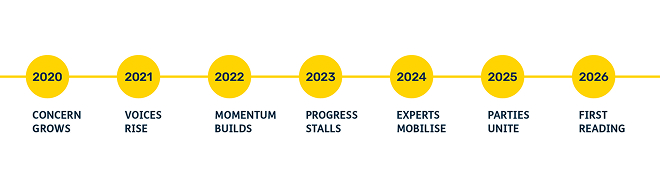
Timeline of the Bill’s journey through Parliament.
Greg Fleming reflected something similar. He said that without the persistence of advocates over the years, this simply wouldn’t have happened. That it is, in a very real sense, proof that advocacy works.
There is still much work ahead. But this milestone is worth pausing to reflect on. I printed a copy of Parliament’s Order Paper for Wednesday 29 April 2026 so that on the days when my hope is low or the obstacles feel insurmountable, I can remember the Modern Slavery Bill. It’s a reminder of what can happen when people refuse to give up. When they add their voice, again and again, even when change feels slow. Over time, justice can reshape the landscape in ways we never thought possible, making a way where there wasn’t one before.
If you’ve signed a petition, made a submission, supported this work, or simply cared about this issue, you’ve been part of that. And it’s still moving.
Why this matters
Modern slavery is not just an overseas issue. Products Kiwis use every day, like coffee, electronics and clothing, can be linked to exploitation in global supply chains..
Timeline
|
2020
|
2021
|
2022
|
2023
|
2024
|
2025
|
2026
|
|
Concern grows
|
Momentum builds
|
Experts mobilise
|
Voices rise
|
Progress stalls
|
Parties unite
|
First reading
|
Read more Correspondent stories
Read More