Over the course of a week, Tearfund CEO Ian McInnes shared personal reflections as he travelled across districts in Nepal, devastated from the recent flash floods. As he met with our partner on the ground, Share and Care, and heard heartbreaking stories from the communities most impacted, posts on his personal Facebook page kept us up to date.
Ian was accompanied by Tearfund Programme Specialist and Nepal Liaison Jeevan Karki, and Stuff/ThreeNews Senior Correspondent Lisette Reymer and Camera Operator Hannah Warburton.
The daily accounts have been copied directly from Ian’s Facebook posts, amended only for spelling.
 23 September 2026
Post #1
The ThreeNews team are travelling with Tearfund in Nepal. We’re off to visit communities being helped by our partner high in the hill country.
This is the coverage from the journey today, as we wound our way along the muddy tracks beside the Trishuli River. All bridges are gone! That makes the drive up particularly challenging with muddy single-track roads being the only option now for navigating the river valley.
Post #2
This is what it takes to get the news in Nepal. Lisette and Hannah from ThreeNews work like troopers putting the shots and the first bulletin together.
We’re on the journey up the Trishuli River valley to the most devastated regions where Tearfund’s partner is distributing aid.
24 September 2026
Post #3
We’re in Nepal. Today we reached the most affected areas. The devastation is absolute and is shocking to witness.
We met families whose entire riverside village was washed downstream. The flash flood hurtled through this area, scouring everything back to bedrock, and took lives and livelihoods with it. The stories are heartbreaking.
It’s been 15 hours on the road to reach this point.
The ThreeNews team will cover the story of one family here tonight. That’s them editing the story on the very bouncy road back to our simple village guest house.
|
TEAMS POST
to Tearfund Staff
|
Movement change planned due to weather.
The weather is about to set in, with rain expected for the next few days. Locals tell us the roads remain passable, and the land does drain at this time of year. Nonetheless, as a precaution, we will finish up shooting in Rasuwa District this morning, filming a distribution then a ThreeNews live cross at midday.
Then we will return to Nuwakot (where we stayed two nights ago) in the afternoon—and in daylight. This will bring us halfway back to Kathmandu. It’s still a very muddy journey back from there, but we will bank on the road remaining open.
|
25 September 2026
Post #4
Today’s story from Nepal. ThreeNews covered a school doubling as a shelter. I strongly encourage you to watch the 6pm ThreeNews bulletin, where the full story of the flash flood will be told through the eyes of some beautiful local people and some epic drone footage.
Post #5
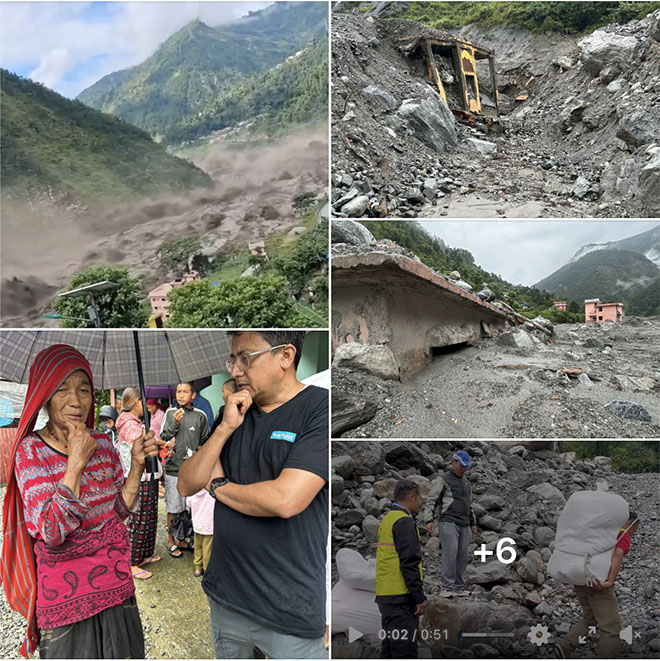
Sukmaya Tamang is 70. I’m in Nepal and we spoke with her today. She lost her son, a worker in the hydrostation on the river. He left behind two children aged 7 and 10. Their mother is abroad in Kuwait working as a domestic helper, as so many Nepali women from poorer communities are. “How can I raise them; I am 70 years old,” she says. She still hopes her son’s body might be recovered, but 39 men died in the hydro station tunnel and their bodies remain trapped beneath silt. She is pictured here, talking with Jeevan, the Tearfund Programmes Specialist.
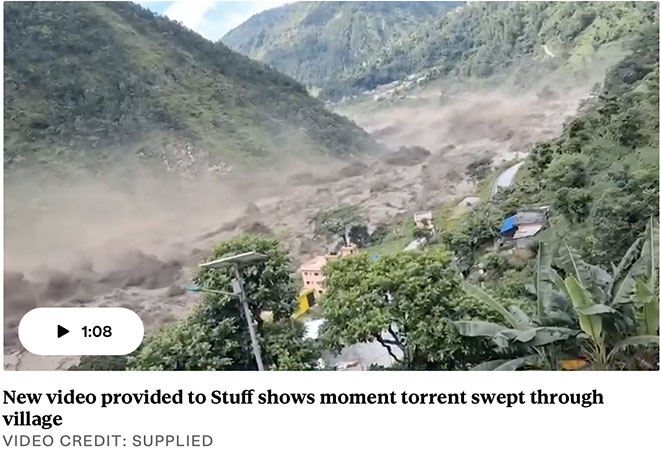
A man gave us footage from his phone from the day of the flash flood. It shows a staggering volume of mud, ice and water tearing through the hydro village, taking all in its path.
Today, we picked our way along the same route, in exactly the same place, with our local parter staff lugging sacks of aid. They packed them in like Nepali Porters, and distributed the aid to those who remain; clothing, toiletries and hygiene items mostly for women. Too many of the men are dead.
ThreeNews, who are traveling with us, did a full report from the area on the 6pm news tonight.
This has been a deeply moving day for all of us.
Post #6
ThreeNews reporter Lisette Reymer has been traveling with Tearfund, and she delivers this moving story right from the heart of Nepal’s most devastated region from the flash flood. The scale of destruction is almost unfathomable and she reports on that here.
26 September 2026
Post #7
The Stuff article including new footage of the moment the wall of water arrived. It’s from our visit yesterday to the hydropower village of Simle, where the stories of the flash flood were particularly harrowing.
Tonight’s ThreeNews will carry the full story from Lisette Reymer, their Senior Correspondent.
Post #8
The hydropower plant and the village built around it are gone. If you watch only one news story from the ThreeNews team traveling with Tearfund in Nepal, make it this one.
Today, we delivered aid to what remains of the upper village of Simle. Lisette documented that, along with the full impact of the flash flood on this village. So many lives have been upended. The rebuild ahead is mind-boggling. I doubt they will ever build again along the immediate riverbank. It’s been so transformed and so have they.
Without the hydrostation there is little work for those who remain. Women have been left widowed after 39 men were trapped and died in the hydro tunnels. Children are orphaned and we speak with them. Their parents and homes swept away. They survived as they were at school on higher ground, and they have been taken in by other survivors.
I have spent 22 years in disaster response work, and I have never seen a river flood like this. The speed, the lack of warning, the dynamics of a glacial collapse with its cement-like composition, and sheer volume of material are all new to me.
It has been shocking to behold.
I thank God for Tearfund’s partner here, Share and Care Nepal, and the fact that we can do something to assist.
Post #9
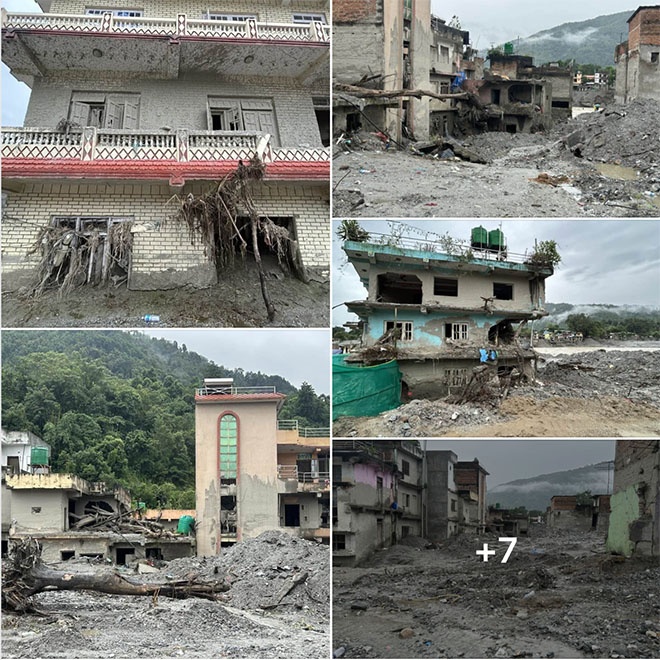
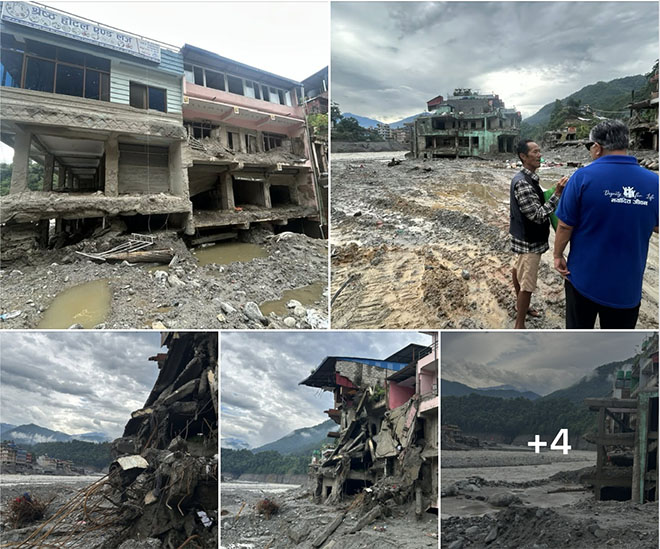
The town of Devighat is a pretty little town that sits at the juncture of the Trishuli River and a key tributary. It took a direct hit in the flash flood. Silt and mud have inundated the third floor of some houses. 270 families evacuated with minutes to spare. It sat just far enough downstream to heed the warning of the carnage to come.
I’ve not seen flood destruction like this since the Boxing Day Tsunami of 2004. Even then, I don’t recall it hitting the third floor!
Normally we would tell stories through the eyes of local people. But this is a ghost town now. Completely uninhabitable and its residents have moved—every single one of them. It’s not hard to see why.
Post #10
The town of Devighat sits at the juncture of the Trishuli River and a key tributary. It took a direct hit in the flash flood. I share my thoughts on seeing that firsthand here. It’s well down the river from the hydropower village we were at yesterday and people had just enough warning to evacuate.
27 September 2026
Post #11
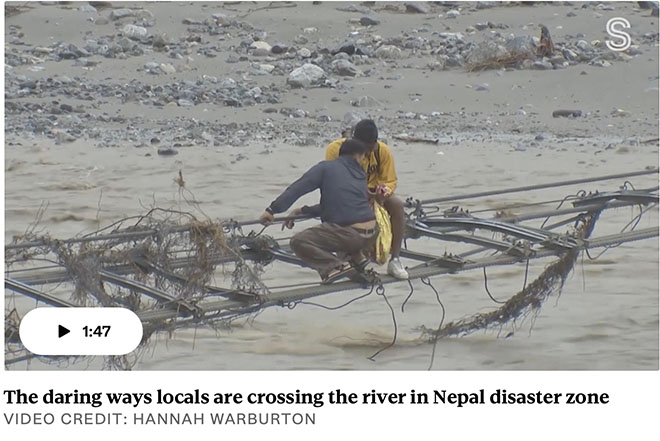
People are risking their lives to cross the river. The bridges are gone. We were horrified to watch these two navigate an all but dismantled swing bridge above the torrent of the Trishuli River, the very one that the glacier flood came down.
I speak with the ThreeNews crew traveling with us here about the risk of this happening again. The glaciers are warming in the upper Himalayan region that feed these lifelines through Nepal. That is making them increasing unstable.
Nepal is bearing the brunt of the climate emergency, and it does not have the resource or infrastructure to fight it.
Some say aid agencies should stick to their knitting, and we largely do. We respond when disaster strikes. But we also care about what lies upstream. In this case, it's the changing climate, for which we all take responsibility, and an increasing tenuous Himalayan alpine environment.
Post #12
Like its sister town Devighat, this community at Bidur was just as hard hit. Its residents also evacuated. Some didn’t make it up the hill behind the town in time.
ThreeNews put a drone up to get perspective.
It’s things like the hospital being on the other side of the river now, with no interconnecting bridge. Men were running power lines from roof to roof just to get some street lighting back! Seven diggers (JCBs) in a line were stationed on the edge of town, in preparation for moving the silt.
A small family photo album lay open where it had come to rest near the door of a home. It pictured siblings in school uniforms—too personal to share. I only hope the children made it to safety.
It’s hard to imagine what a rebuild will take, and where to even begin.
Next, I cover the distribution of items to its residents in preparation for the winter ahead.
Post #13
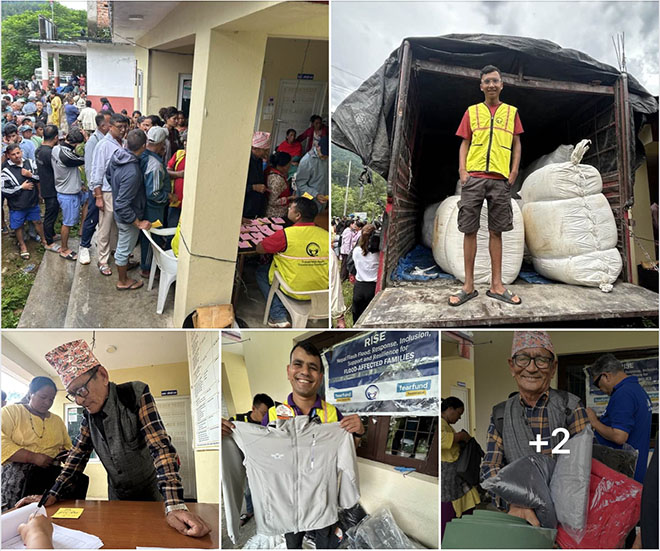
Nabinra Lal reaches the front of the queue, signs his name off the list, takes a stamped card to the Share and Care team members and picks up his winter supplies. He has a generous smile and is happy to talk.
He lost his house and all his possessions, but fortunately his children were all in Kathmandu on the day the flash flood took his town away. Asked about the aid, he says, “This is very useful and thank you so much for providing this help.” It is, of course, the least we can do.
This is what’s called, in cryptic aid parlance, ‘Winterisation’. He received two winter jackets (pictured), two bed rolls, two duvets, and blankets. It will help him survive the cold through the months ahead. This augments food, toiletries, hygiene items, and shelter kits for erecting makeshift accommodation while a more permanent solution is found. The Government is contemplating applying a no-build exclusion zone along the riverbank to reduce loss of life in future flood events. Understandable, though it’s hard to see how they will implement that.
Nabinra has a Nepali resilience that’s becoming familiar to me now. But it won’t solve all his questions. Meanwhile we’ll keep walking with him through the days and months ahead.
Post #14
How does an aid distribution work? It’s pretty simple really. In this rather amateur footage I show you around the distribution of items for winter—blankets, bed mats, jackets, duvets.
To see what happened to the homes of these people at Bidur, see my earlier post. Their town is three storeys deep in silt.
If you’d like to donate to this response, we’d welcome that.
Post #15
I speak with Lisette Reymer of ThreeNews in this story about my concerns that climate change is making humanitarian catastrophes only more likely in Nepal.
28 September 2026
Post #16
Lisette puts together today's story; the washed-out town of Bidur, and Tearfund's aid being distributed as people prepare for winter here.
Post #17
Lisette covers the extraordinary means by which people are choosing to cross the river here in Nepal, following the flash floods. With 41 bridges out they feel they have no choice but to take risks like this to survive. The only comfort I took was that they were wearing Tivas and shoes, and not the ordinary flip flops!
Post #18
In a town that has no idea how it will rebuild, we meet a mountain trekking organiser with links to New Zealand who was caught in the tragedy.
Sunaram Tamang worked with Hillary Family Group Treks. He tells us he grabbed his wife when he heard the flood coming. She said, "I've got to run back for the phone and call my kids." He tried to stop her, but she was swept away. We talked for some time, and ThreeNews interviewed him here.
All the stories are heartbreaking, but they touch you harder when you establish the connections.
In the month since the flash flood, I have met and got to know Alexander Hillary a little. The Himalayan Trust he now leads, as a legacy to his father and grandfather’s work, has deep connections here. He will be saddened to learn of this. Sunaram is a lovely man with a tough road ahead.
29 September 2026
Post #19
As I leave Nepal tomorrow, this will be one of my lasting memories. We spent most of the 15 hours each way to access flood-stricken communities driving like this. Much of it close to sheer drops, gaining huge altitude only to wind down, then go up again. Our drivers were exceptional. I’ve never been on anything quite like it.
For seven days the Tearfund and Stuff teams walked alongside those experiencing life after a catastrophic disaster. They heard stories of unimaginable loss and uncertainty about the future. Yet throughout, the resilience of the people they met, and their hope for the future came through. The team have returned home, but thousands remain, seeking to find a new way forward.
News headlines will move on, but our partner will remain. Showing up day after day, they'll continue to serve these communities.
If you would like to join this response your donation will enable our partner to provide urgent care for the families affected and support them in the coming months as they rebuild their lives.
Help Families in Nepal