“Nasituan was born in the nakamal. It grew up in the nakamal, lived in the nakamal, and it will be there in the nakamal.”
As I followed his footsteps, Nini shared these words with me on the high roads between the main township of Lenakel and the remote village of Ianapkasu, in southwest Tanna, Vanuatu.
I came to understand the nakamal, not only as a physical clearing in every village, but as the beating heart of every community. It was the place where stories were told, decisions were made, and custom rituals were celebrated.
I had been on Tanna Island three days by this point and had more questions than answers. We were on our way to visit one of our partner's coffee farming communities in a remote village. ‘We travel four to six times a week,’ Natonga told me. ‘It can cost 15,000 vatu* for the farmers to get to Lenakel township from here, so we collect the beans for them.’
We had spent the morning trying to get there—a journey that would have been impossible without someone who knew the way. During my week with the Nasituan team, I realised that finding our way into these communities was about much more than knowing the roads.
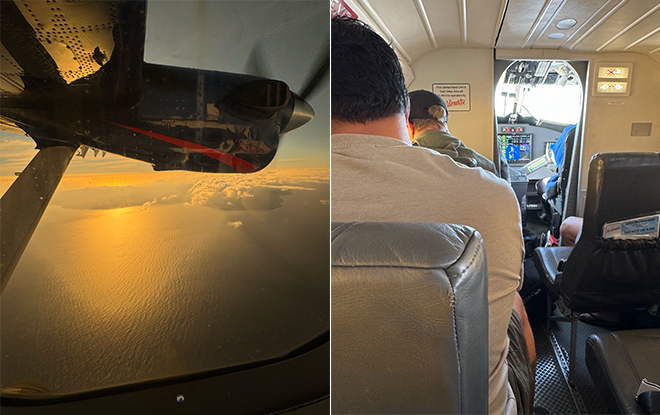
DHC-6 Twin Otter sunrise flight, and our view into the cockpit.
The journey to Tanna
After two flights and one overnight layover, we arrived on Tanna Island.
The flight from New Zealand was a luxurious A320 in comparison to the DHC-6 Twin Otter carrying a maximum of 20 passengers from Port Vila to Tanna. Jumping on this toy plane, with the engines revving hard, we could see both the wings and the wheels, and the ground beneath us, all in one go. I experienced this through a lens of curiosity: Will we survive this? Let's wait and see!
Our first stop was Tanna Gardens, the business enterprise arm of our local NGO partner Nasituan. After introductions, a morning coffee (it would be rude not to!), devotions and a morning interviewing staff, Jared and I shadowed our programme team Olivia, Andrew and Clint. Together, we joined some of the Nasituan team to Iwel Village, for a workshop and consultation with local community reps.
It took us about 30 minutes over bumpy dirt roads, deep ruts and potholes, veering from one side of the road to the other to avoid them, frequently causing a forgetfulness about which side of the road we were supposed to be driving on. This didn’t seem to bother Andrew, and I relaxed, realising he understood these roads well. I was glad of his careful navigation.
A couple days later Andrew mentioned we would be going to Ianapkasu—a remote village in the hills central to the island. With a nervous laugh he warned us of the roads, and the curiosity kicked in again: I thought these roads were bad!
When the road runs out
Following the Tanna Gardens Landcruiser, we loaded into the Hilux and headed out the gate. As we turned off the coastal roads and headed inland, we quickly navigated steep inclines. The rain from the previous day had turned the dirt tracks into boggy, slippery mudholes. With Jared in the front seat clutching his camera gear tightly, and me in the back capturing what I could on my phone, we reached a particularly precarious part. I had to stop filming so one hand could be pressed securely against the car ceiling, with the other held firmly to the side.
Andrew calmly suggested we wind up the windows, “just in case we roll.”
We would breathe a sigh of relief every time we breached a hilltop or turned a corner to reveal a protected dry section of road. I can't remember how many times Andrew warned us we might have to turn back.
First, the Hilux gave up navigating the terrain, and then, with wheels spinning, the Landcruiser succumbed to the quagmire too.
We abandoned the 4WDs and made the rest of the journey on foot, following Nini and the team over hills, around bends and through the bush.
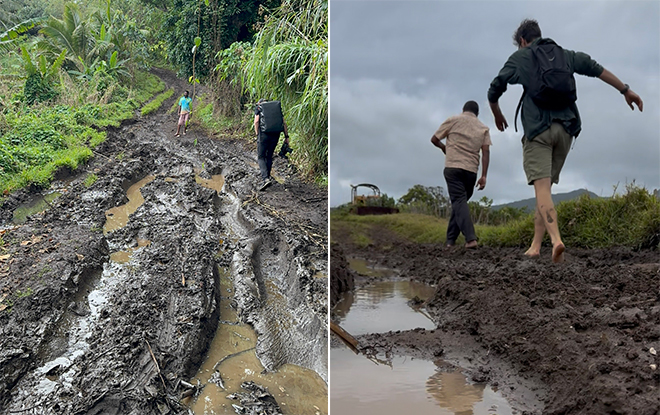
(Photo - L) The road to Ianapkasu, in Middlebush, central Tanna, Vanuatu. (Photo - R) Following Nini on the high roads..
Finding a way in
As we walked, with the rustling of the wind in the trees interrupted only by sounds of local custom celebrations carrying in the air, Nini and I talked.
Before joining Nasituan as the NGO Manager, he had been a teacher for 19 years. Even on those remote high roads, we would come across former students. We would hear the yells, “Halo tija!” Nini would tell me of his heart for his students, which went beyond their school years to help and support them into new opportunities.
We followed his footsteps through unmarked paths and held back as clearings gave way to new communities. With certainty, he would guide us to the chief to introduce ourselves with handshakes and “Halo.” When we reached remote communities where Bislama, an official language we had come to recognise, gave way to indigenous languages we had not heard before, Nini covered us. He formed the connection that entrusted us to be guided through their village, ask questions, take photos and film their farmers sharing about the difference Nasituan had made to their families and community.
This experience stayed with me throughout the week and was daily built on as we travelled with other members of the Nasituan team. Frequent hollers from the side of the road as the Tanna Gardens truck rolled past, a wave back and a shout from Natonga—our driver, Tanna Gardens Manager, and sometimes translator.
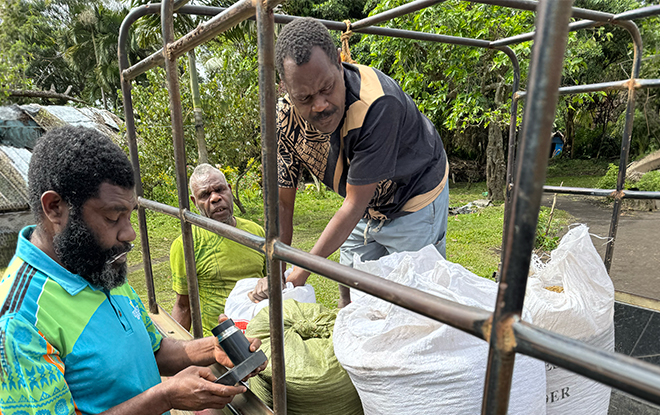
Nasituan team: Tom on the truck, while Natonga tests moisture levels in the coffee beans, and farmer Tomle looks on.
Growing more than coffee
As we travelled from place to place, I was keen to know if he had seen a difference in the lives of these farmers.
“Their children can go to school, their crops are healthy, and I can see that their standard of living has improved,” he told me.
As we interviewed farmers, we heard the gratitude in their voices for the work that Nasituan was doing. They were given seedlings to plant, water tanks to sustain their crops, training to multiply their harvest, and a fair market price to ensure a sustainable livelihood. Nasituan provided not only a practical service, but a lifeline where hope for the future was achievable and certain.
I was daily humbled by the work of our partner in creating real and lasting change for these communities. Happy children, farmers proud to show us their crops, certainty for their families with education and necessities within reach.
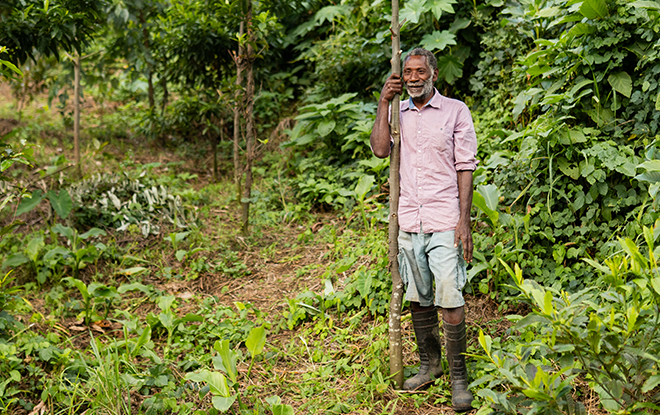
Nako standing with one of the seedlings he planted, now grown.
Sowing hope for the future
As I walked those hilltops with Nini, I heard how his heart went beyond coffee farming.
Drawing inspiration from Genesis 2, he shared his hope to see the “dark bush” return—the native trees that once flourished, provided a diverse ecosystem of plant life, flying foxes, prawns, fish and birds. Some of the Nasituan staff have lived enough years to remember those days, and with the backing of MFAT and Tearfund supporters, have started restoring the forest.
Earlier that week we had visited Iwel—near the village where Nasituan was born, and home to one of three native tree nurseries, and meeting place for the local chiefs and community committee who have been working to protect and restore local land. We spoke with Nako, who contributed to the planting of 20,000 trees in the last two years. We spoke with Agnes, the committee secretary, who reminisced with us about her memories of the ‘dark bush’ as a pikinini (young child). Now part of the work in reforesting these areas, her face lit up when we asked about her hope for the future.
Margaret, pregnant with her fourth child and standing with her eldest, Rebecca, shared how honoured she was to be elected Vice Chair of the committee, giving her the opportunity to speak on behalf of her community, and join decision-making in the nakamal, where traditionally only men would be allowed.
Nini stood by quietly, affirming this step of progress.
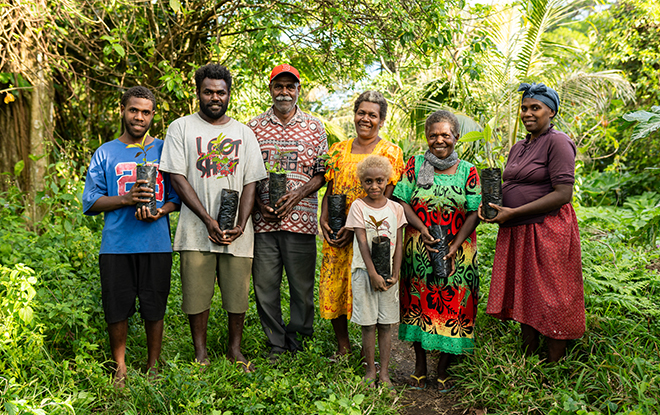
Members of Iwel Village, including (from R-L) Margaret, Agnes, and young Rebecca holding native tree seedlings.
The road ahead
As my time on Tanna came to a close, I found some moments to reflect on what I had experienced.
Whether we sat in workshops with chiefs and local committee members, ventured into remote bush and came across landowners, or trundled into coffee plantations to meet with coffee farmers, the Nasituan staff formed a bridge for us to be welcomed and trusted by the communities.
Our heart at Tearfund is to walk alongside communities, to listen, and to smooth the road for the solutions they see will change their future. It was humbling to see Nasituan take this approach with the local communities too. Committees were formed with representatives from the surrounding villages to ensure equal voice was heard. Together we listened, and while space was made for one another, connections were formed and strengthened.
Hope for a different future was born in the nakamal, grew in the nakamal, lived in the nakamal, and has returned to the nakamal. And day by day, it is being carried forward by the people of these communities—for their families, their lives, and their land—to serve generations to come.
*15,000 vatu is approximately NZ$215
Read the related blog, Making Room in Vanuatu, here.
Sow seeds for future generations
Read More